Thursday, July 22, 2010

Kosher on the Continent

Since my return last week from Europe, I have wanted to write to you about Hermolis.Com. (Nooooo, I don't get a percentage, or even a company pen. I just am so grateful to them for making out stay in England so simple.) Hermolis provided all our meals in London - breakfast, lunch and dinner. They even sent over a delicious Hermolis birthday cake for my sister's birthday.
Every morning we arose to a delicious breakfast with everything we needed - yogurt, eggs, fruit salad, orange juice, etc. For lunch they sent us sandwiches for our tiyulim (tours). And at night, our dinners were just delicious - veal, roast beef, chicken.
You see, if you're not familiar with which brands are permissible, England is not the simplest place to obtain kosher food. There are few kashruth certifications on food. It's not like the US, which has certifications on every kosher product - and there are zillions.
In London, you can get tons of certified CHALAL food (that's kosher for Muslims), but Jewish kashruth certificates were not that readily visible.
My friend forwarded me to a book about keeping kosher in England. I kept it with me at all times, but using the book wasn't as easy as you'd think. Many items/stores are just not even mentioned.
The Hermolis Giant
Then, there was Hermolis.
Hermolis began as a restaurant operator almost 50 years ago. Today Hermolis and Company Ltd is Europe's largest manufacturer of Kosher foods.
Its food is under the kashruth supervision of "Kedassia" which is the most stringent religious organisation in this country and accepted worldwide.
They deliver their delicious food all over Europe. For a kosher traveler, that's a real bracha (blessing).
If you're going traveling in the upcoming year, stop worrying where your next meal will come from. Just contact www.hermolis.com and let them do the rest. Just remember your camera.

Wednesday, July 21, 2010

History and Me - Lachish Destroyed, Lachish Rebuilt - Part 1

I think we all know that all of life and history is interconnected. So how do I fit in with Lachish, the Assyrians and Gush Katif? Have a long listen!
As I left the British Museum two weeks ago, after a day of historical window-hopping, I saw ME hanging on the wall. Well, I thought it was me. About eight years ago, in the second Raise Your Spirits theater production, ESTHER and the Secrets of the King's Court, I played the semi-wicked, semi-bright King Achashverosh – Xerxes, to the outside world.
There on the wall of the British Museum, I thought I was looking right at my stage alter-ego. Suddenly I got my second wind, and asked my family to sit down and relax while I explored a bit further.
Reading the plaque under the wall-sculpture, I sighed in disappointment. It wasn't Achashverosh (above left, who ruled Iran when it was Persia – 486 BCE) after all, but an earlier Iranian ruler, Tiglath-pileser III (immediately left, king of Assyria in 745 BCE). Well, you can't blame me; they kind of look alike, except for the hat.
Since I was already in the Assyrian section of the museum, I thought I'd take a quick look. After Tiglath-pileser III became king of Assyria, among his many military feats, he conquered Ashkelon, one of the five Philistine cities (along with Gaza, Gath, Ekron and Ashdod). Even after our beloved scholar-warrior king David defeated the Philistines in many of their strongholds, he could not remove them from Ashkelon. It took the Assyrian conqueror Tiglath-Pileser III to do so in 734 B.C.E. And so, after about 600 years in, and neighboring the Land of Israel, the Philistines finally disappeared forever, B"H. Thanks for that, T-P.
Unfortunately, this Tiglath-Pileser III started the cataclysmic destruction of the Northern Kingdom, Samaria and the Exile of the Twelve Tribes. Because of T-P and the Assyrian Kings after him, our brethren have been scattered throughout the world for thousands of years. Our nation is incomplete, and we are always searching for our lost kinsmen.
Who were these Assyrian conquerors? As I walked further through the Assyrian section, I drifted into a room that stunned me. I had read about it in the spell-binding book Purim and the Persian Empire by Yehuda Landy, but seeing it in real life was so much more powerful. Yehuda Landy wrote, "In Sennacherib's palace at Nineveh, a central room was dedicated to his siege and conquest of the Judean city of Lachish [in the northern Negev near Ashkelon and Kiryat Gat]. It was one of Sennacherib's major campaigns, taking place during the sixth year of his reign, in which he marched his entire army from Nineveh to Judea."
Continue to Lachish Part 2

History and Me - Lachish 2

LACHISH??
Lachish? Why on earth would the mighty warrior and king Sennacherib dedicate an entire room in his palace in Khorsabad to the Judean town of Lachish? The Assyrian kings had conquered an empire stretching from Egypt to Iran. Sennacherib had conquered Elam in Southwestern Iran and Babylonia. But hanging over him always was the fact that his fathers before him had destroyed the majority of the Land of Israel. He must have felt that it was his destiny to finish the job.
Lachish was a city made great by King Solomon's son Rechavam. It controlled the passageway from the coast to the capital. So, not to leave anything to chance, Sennacherib marched his entire Army to Judea. He laid a mega-siege to Lachish, and when he conquered it, ahhhhhhh, he probably believed, this was the beginning of the complete subjugation of all of Judea, and ultimately Jerusalem. So intoxicated was he with his own power and domination after the capture of Lachish, he actually dedicated an entire room in his palace at Khorsabad (next to ancient Nineveh) to this battle of 701 BC.
There around the British Museum were these sculpted reliefs of the Assyrian conquest of Lachish. They were so lifelike. I saw the faces of my brothers, anguished and weary. I saw the haughty Assyrian soldiers and their mighty war machine. I stroked the shoulders of the Jewish slaves and tried to console them through the millenia.
I slowly inched from panel to panel, engrossed in each scene, helpless to change the outcome of Sennacherib's assault.
The Capture of Lachish, according to the British Museum:
"In 701 BC, Hezekiah, king of Judah, was implicated in a rebellion against Assyrian rule in Palestine [my emphasis, because there was no Palestine then, not at all. There was Israel and Judea. So why did they write that? Does the BM have a political agenda? If so, well...changing history is not appropriate for such a respected institution.]."
"Sennacherib, king of Assyria, attacked and defeated the rebels and their Egyptians allies. He did not capture Hezekiah's capital, Jerusalem, he may not even have planned to [my emphasis], but instead he devastated the very strong and important city of Lachish." (Liar, I screamed at the sign. I was wild with anger. Liar. Folks in the museum turned around. Liar, I told them Sennacherib marched against Jerusalem with 185,000 soldiers and G-d made a miracle and killed them all. Sennacherib was panting to destroy Jerusalem. That sign in the British Museum did not tell the real story. Was that an intentional political move, like calling Eretz Yisrael "Palestine" when there was no "Palestine", or was it a mistake from lack of research? I didn't know, but I was outraged. The parents took their children by the hand and sidled away from me.)
Not only did Sennacherib want to destroy Jerusalem, he was obsessed with defeating the Judean king Chezkiyahu (Hezekiah). A full two chapters of Kings II – 18 and 19 – are packed with Sennacherib's fixation on Jerusalem. First he captured Lachish and the cities of Judea. Then he sent his generals from Lachish to King Hezekiah in Jerusalem. They called to the Jews of Jerusalem to surrender, telling them not to delude themselves into thinking Hashem would save them. They said, no gods of any nation that the Assyrians attacked ever saved their people. Just as the Assyrians had destroyed all the lands before them, they would destroy Jerusalem. They told residents to give up, and allow the Assyrians to bring them "to a land like your land," i.e. exile them from their homeland to a faraway place.
But Hezekiah and the people prayed and repented, and the generals continued to deride Hashem (which was a b-i-g mistake). "Who of all the gods of these countries has been able to save his land from me? How then can the L-rd deliver Jerusalem from my hand?" (Kings II 18: 35)
Ha, a double dare, eh! So Hashem declared that the King of Assyria would not enter Jerusalem, or even shoot an arrow there or put up his ramp against it. "I shall protect this city, to save it, for My sake and for the sake of My servant David." (Kings II 19:34)
Yes, the Assyrians intended and did their best to conquer Jerusalem with a force of 185,000 warriors. And on that very night, an angel of Hashem went out and struck down the entire camp. "The rest rose in the morning and behold – they were all dead corpses!"…So after his war against Hashem, Sennacherib returned a defeated man to Nineveh, where he was killed by his own sons.
(Jerusalem and Judea were safe until Nebuchadnezzar in 586 BCE destroyed the Holy Temple, Jerusalem and the cities of Judea.)
Continue to Lachish Part 3

History and Me - Lachish 3

LACHISH AGAIN
At the beginning of the new State of Israel, Lachish was desolate and Arabs infiltrated from Gaza through the region. It was partially awakened in 1955 by the founding of 15 moshavim and one village. Jewish immigrants of North Africa and Arab countries were settled there to plow and plant large luxurious fields of colorful flowers and delicious grapes.
Although 15 moshavim dot Lachish's 500,000 dunams (about 193 sq. miles, 500 sq. kilometers, or 125,000 acres), it is sparsely populated with only 7,500 residents (less than my home town of Efrat alone).
But Lachish is bursting forth with life once again. Jews were expelled from Lachish 2700 years ago, and now expelled Jews are returning there. Tractors and plows are preparing the land, and workers are scrambling across its hills building homes and public structures for the expelled Jews from Gush Katif.

Five years ago to the day of this writing, 1850 families, approximately 10,000 Jews were taken by force from their homes in Jewish Gaza and brought to hotel rooms, caravans, rejected apartment buildings, and caravilla refugee sites. For five years they have suffered degradation, unemployment, underemployment, bureaucracy, illness, divorce, heartbreak, drugs, evils of society that they had never known in their paradise-like existence on the sands of Gaza.
Now finally some of the communities are in the first stages of being reborn – infrastructure has been completed in six towns, construction of the first houses has begun in nine locations. In five locations nothing has yet commenced.
Lachish is one of the regions where infrastructure has begun at one site, and nothing has moved at another.
Ultimately, according to Friends of Gush Katif, the new communities of Bnei Dekalim, Neta, Amatzia and Shomriya will bring 1,000 families to the Lachish area, IY"H, many of them from former Gush Katif communities.
Last year, my family and I attended the ground breaking of the new Bnei Dekalim town. Thousands of people attended, all eager to wish our GK friends a speedy uneventful building process. Lachish will be a tapestry of GK towns. Families of Tel Katifa and Neve Dekalim are making the Lachish town of Shekef their home. Mirsham/Neta will be the home of expelled families from Kfar Darom and Tel Katifa. Neve Dekalim refugees are full-speed ahead building Bnei Dekalim. Plans call for 500 families there. A new community Kerem Ami will a mixed secular religious town with 220 families one day, IY"H.
Bnei Dekalim, the most advanced, will live in concert with nature, and add green values on to its orange ones.
Lachish will live again in vibrancy and passion. Jews will bring enthusiasm and dedication to their national mission. And the Assyrians, where are they? Dust and a sign at a museum.

Monday, July 19, 2010

History and Me - The Sisera Discovery

A few weeks ago, a 13 year old mystery was solved. Archaeologists had uncovered a 3,200-year-old round bronze tablet with a carved face of a woman at an excavation site that they believe was Harosheth Haggoyim, the local base of Sisera, captain of the Canaanite Army of King Yavin.
Archaeologists from the University of Haifa realized that the tablet, found at the El-ahwat excavation site near Katzir, is part of a linchpin that held the wheel of a battle chariot in place.
Oren Cohen of the Zinman Institute of Archaeology at the University of Haifa was quoted as saying that the round, bronze tablet, about 2 cm. in diameter and 5 mm. thick, features a carved face of a woman wearing a cap and earrings shaped as chariot wheels.
While studying ancient Egyptian reliefs depicting chariot battles, Professor Cohen noticed unique decorations! -The bronze linchpins fastening the chariot wheels of royalty and distinguished individuals were decorated with people’s faces. Cohen explained that these faces were those of captives, foreigners and enemies of Egypt.
I disagree.
If you were Sisera, the supreme leader of the Canaanite Army, would you put the faces of enemies on your gorgeous bronze engraved chariot? I think not.
If you were Sisera, you would take into battle with you something that reminded you of the one you loved the best. That is what warriors have done throughout the generations. Knights took the scarves of their ladies fair. Fighter pilots in World War II wrote the names of the loves they left behind on the nose of their plane.
Today macho fighters write their girls' names in tattoos on their arms.
Sisera must have done something similar. On the linchpin of his chariot, he put the face that meant the most to him in the world.
History and Me
And this is where I enter history. This year the Raise Your Spirits theater company is taking the stage with its latest production "Judge, the Story of Devorah." The show's director, Toby Klein Greenwald (and a co-writer with Yael Valier), sent out notice about the find to our cast: http://www.5tjt.com/international-news/7616-archaeologists-identify-sisera-chariot-in-sefer-shoftim .
Well, in this year's play, I portray Sisera's mother. Nowhere can we find a closer relationship between a mother and son than Sisera and his Mom. The Jewish People even learn how to blow the shofar on our holiest days, Rosh Hashana and Yom Kippur, by the 101 heart wrenching cries of Sisera's mother, when she discovers he has been killed.
The image of Sisera's super-beloved mother waiting by the window has inspired artists throughout the generation to paint that woman who loved her son more than all else. She is the ultimate mother, "Through the window she gazed; Sisera's mother peered through the window, 'Why is his chariot delayed in coming? Why are the hoof beats of the carriages so late?'" (Judges 5:28)
Okay, she was calmed by possibilities of her son's brutality, but it takes a lot to comfort such an attached mother, right? "The wisest of her ladies answered her, and she too, offers herself responses. 'Are they not finding and dividing loot? A comely [captive], for every man; booty of colored garments for Sisera, booty of colored embroidery, colored, doubly embroidered garments for the necks of the looters." (Judges, 5:29-30 - Artscroll Tanach translation)
Really...a soldier goes into battle. His goal is to destroy the enemy and then bring back his gold and silver, weapons and priceless goods. What is Sisera going to bring back? Besides the slave girls (and what mother doesn't want a few more slaves to do the laundry and the cleaning), he's bringing back colored garments and embroidery – clothing and beautiful goods that his mother would love.
If in the heat of battle, he's spending time shopping for his mother, then whose face is going to be on his chariot??….Ba ba boing – his mother's, of course!
And why am I so sure?
Because in preparing for my role as Sisera's mother, I've carefully studied the Story of Devorah, and I know my character and that of my son's very well.
Our relationship is as close as mother and son could ever be. And so, despite what the hoity toity archaeologists and scientists say about the face on the linchpin of Sisera's chariot, I know in my very soul that when my son the general goes into battle, he takes not only my image in his heart, he takes my face on his wheels.
Hey... it even looks like me.

Saturday, July 17, 2010

MADA Education

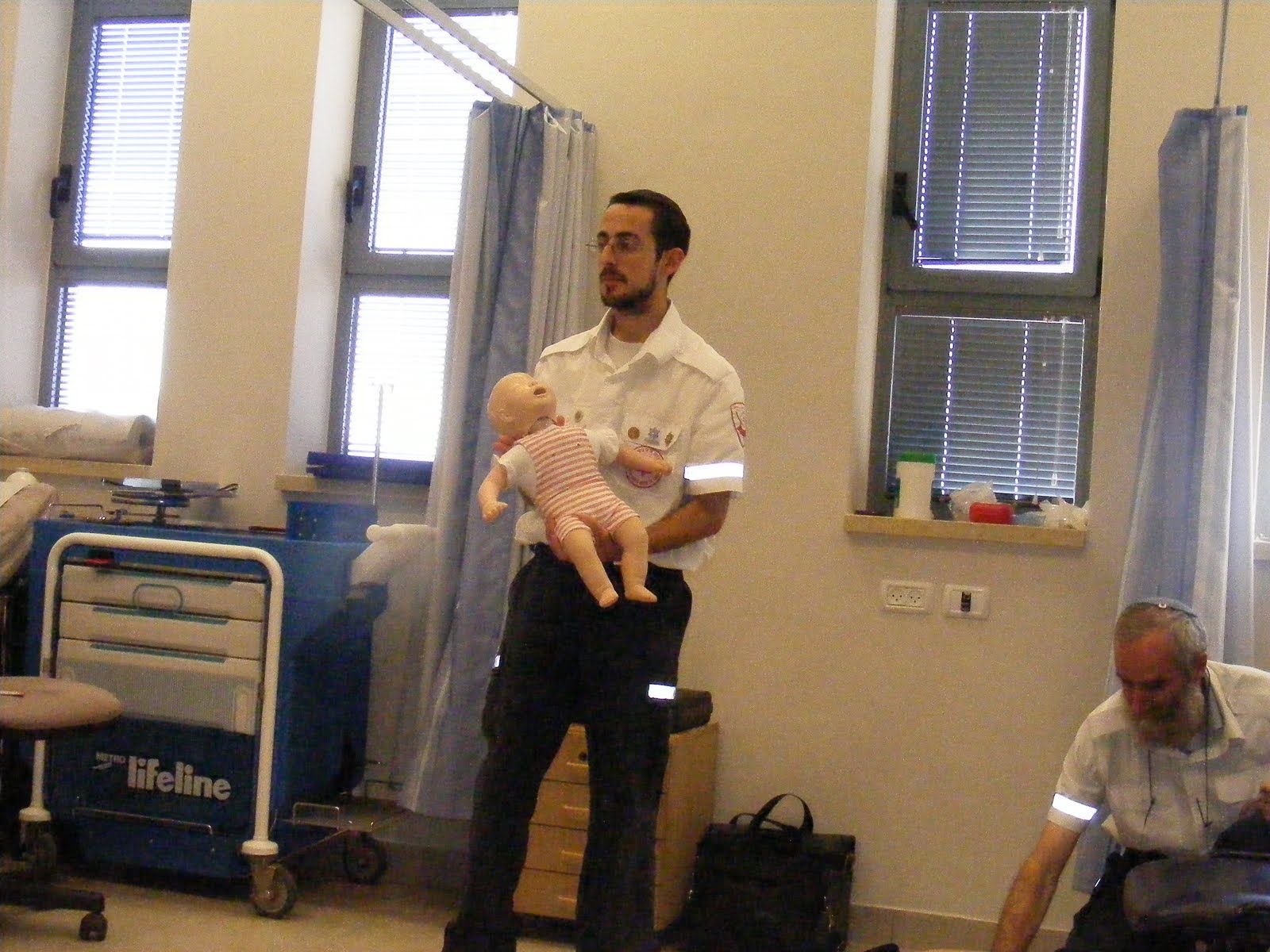
Last week, the Efrat Emergency Medical Center opened its doors to the general public for an afternoon of workshops on CPR. The CPR demonstration was conceived, organized and run by Efrat Magen David Adom personnel.
Sessions ran both in Hebrew and English, as Efratians were taught the rudimentary skills of helping a child or adult who suddenly collapses or chokes.
A large number of MADA (Magen David Adom) Emergency medical personnel were on hand to demonstrate the correct CPR procedures and walk residents through the steps. The workshops were designed theoretically to make ordinary individuals feel that they can make a difference in saving someone's life.
The workshops had rubber dummies in both adult and children sizes so that residents could practice on both. There were First Aid packs available for sale, provided MADA, Jerusalem.
The evening-long initiative was a comprehensive program equipped and funded by the MADA Efrat Team and Efrat's Security Department.
A film ran in the auditorium, showing how a teenage MADA volunteer saved the life of a teacher in the local high school, thanks to the student's CPR training.
I was in awe of everyone who succeeded in understanding how to perform CPR correctly. The session made me understand the importance of CPR, and also realize that I know almost nothing about the CPR procedure. I hope I am never put to the test, but in order to save a life, if it is necessary, I need to really know CPR, and therefore, it caused me and hopefully lots of other people to register for further courses.
I signed up for a 4 hour course, but there are more comprehensive 30 hour courses and even 60 hour courses.
Thanks to all those who planned and participated in this program. Here's to a safer healthier town.
To view the VOICES TV

Friday, July 16, 2010

Positively Fabulous - Redeeming the Land

On Friday morning at Shdema (an abandoned Israeli Army Base - now used as a Jewish cultural center), 50 young people received certificates for their participation in planting almost 20 dunams of Jewish land between Alon Shvut and Elazar. This is area is called Netzer.
Agricultural Zionism!! That is one of the positive directions of the future of Am Yisrael in its Land. Especially now, when we build a house, and it is torn down because of the building freeze, planting Jewish trees and Jewish vines in Eretz Yisrael is a powerfully terrific way to lay claim to our land and help develop it.
Agricultural Zionism is also an idea that plants an even greater love of the Land/the earth of Israel in the hearts of our next generation. It's a way to renew the age-old love that our people have for our land.
Well, it's not a new idea. Jews have been engaging in Agricultural Zionism in modern history since the members of the first waves of Aliyah planted the orchards of our earliest towns, like Rishon LeZion, Netanya, Mazkeret Batya, etc.
The planting this week was part of an Agricultural Camp, set up by Women in Green and the Yibaneh Fund to begin redeeming the last 60 dunams of Jewish land between Alon Shvut and Elazar. The Arabs, along with their European Union and leftwing supporters, have been aggressively planting on this land, wanting to break the continuity between our communities.
No one has stopped the Arabs' illegal and chutzpadik (brazen) planting on Gush Etzion land, and there has been no response until 50 kids rolled up their sleeves to plant Jewish trees in the area. About 15 girls and 35 boys (in separate camps) signed up to work the land. Almost immediately there was a waiting list of 200 teenagers. (If there were more funds for more planting, more teenagers could have been accepted.) This entire week, these young people could be found on our hillsides with the homes of their friends and family in the background.
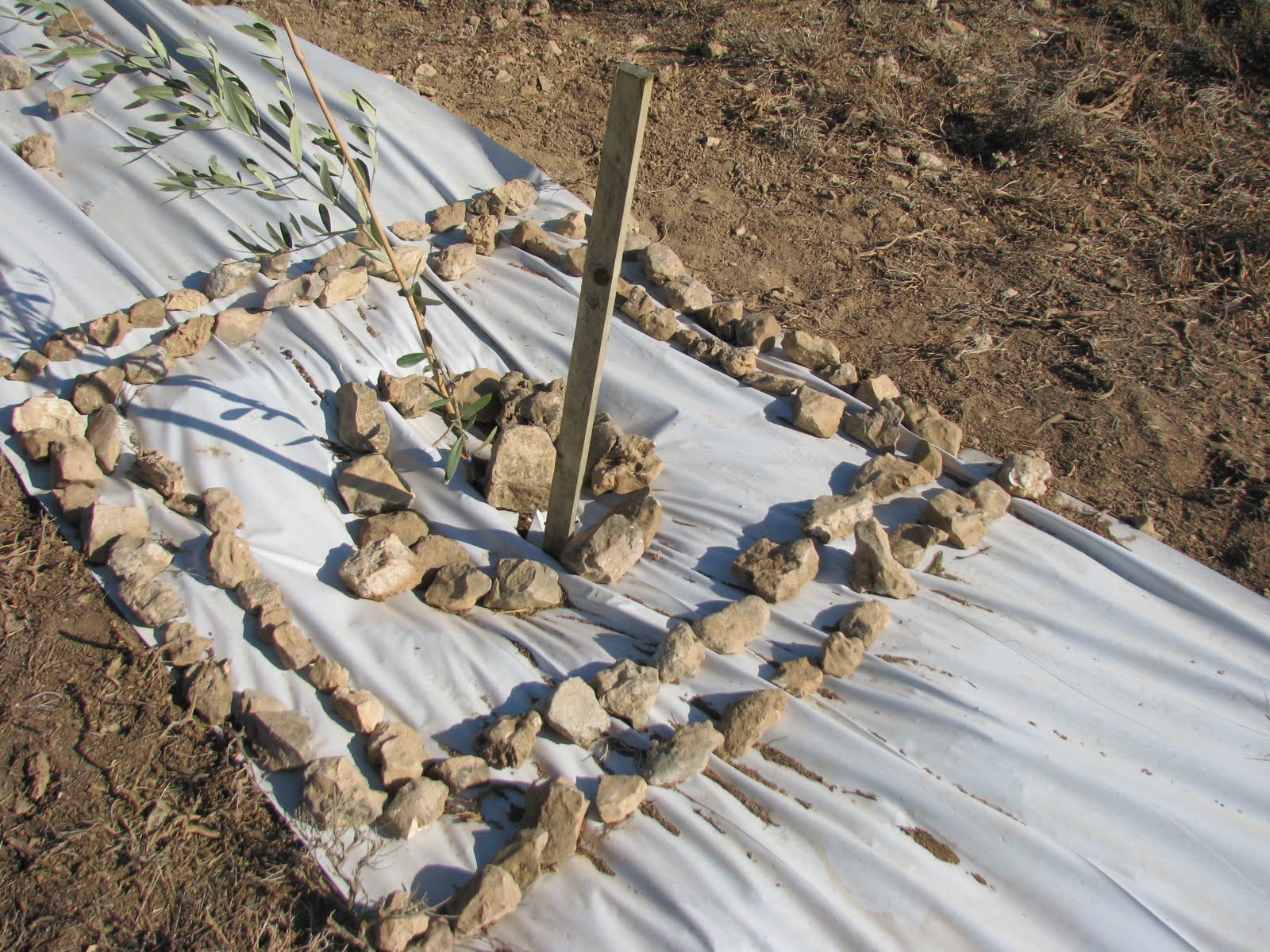
The teenagers worked very hard. The boys were all decked out in work clothes, looking like farming pros, and the girls were on the job in their flip flops and skirts! They all had blisters on the hands and sunburns on their necks. But they didn't stop. The boys worked a very large area near Elazar. The girls worked two smaller areas, both by Alon Shvut and Elazar. They dug holes in the stubbornly hard earth, laid water pipes, put down plastic coverings (so the plants could be raised organically without pesticides), and planted 36 trees and 220 vines on every dunam of land.
I visited the Netzer camps twice and watched the kids reconnecting to Eretz Yisrael. Their pride in their accomplishment was evident on their faces. Their excitement with each sapling that was planted was contageous. They knew exactly why they were planting and what the goal was - redeeming Jewish land and creating Jewish continuity between Alon Shvut and Elazar. They were well-spoken and enthusiastic. Many live in the area and said that they hoped to come during the year to see their trees. Young boy said that one day he hopes to return with his grandchildren and tell them, "Sabba planted this tree."
Congratulations to all the teenagers who participated in Yibaneh' Agricultural Camp. Congratulations to their madrichim (farming supervisors) from the Galil and Jezreel Valley who were as enthusiastic and dedicated to this project as the children. And congratulations to Nadia Matar and Yehudit Katzover who initiated this idea, being proactive in a creative way to build up the land of Israel.