Friday, July 16, 2010

While You Were Cooking....Demo on Zayit

While you were cooking, I went over to the Zayit to see the weekly demonstration by anarchists, leftwing Israelis, vacationing Americans and Arabs. This demonstration is near the fence of the Zayit. After watching an eye-opening video of anarchists/Israelis/Arabs so easily cut through the metal fence in 2007 at Carmei Tzur, I was surprised that the demonstrators were allowed to come so close to the fence.
Right near the Heftziba apartment houses on the Zayit, Arabs were screaming, "1234 Please leave Palestine. 1234 Please leave Palestine." They were taunting Israeli soldiers. And when they saw they were being photographed, they screamed, "Camera, camera." (What was that supposed to do?)
Today's demonstration was haughty, more than violent. (I guess many demonstrators were at the beach.) Zayit residents have said that it is sometimes violent.
SPREADING DEMONSTRATIONS
The weekly demonstrations vary in size, but in general, the movement for these demonstrations is becoming more popular and getting more support. The demonstrators have a brilliant system that saves manpower and exerts the most damage possible.
They rent a bus and bring demonstrators from place to place. They demonstrate an hour here, then an hour there, and back on the bus. Locals or demonstrators particular for that location join them. They don't really have a message - sometimes they're against the wall, sometimes settlement, but mostly they're against the existence of the State of Israel.
While the majority of demonstrators are not local Arabs, unfortunately they fire up the local Arab community to continue their work, trying to intimidate the soldiers and the Jewish town they are accosting.
While the demonstrations started with only a few isolated areas, they are now up to ten locations. In the Efrat/Gush Etzion region, the demonstrations against Carmei Tzur are getting increasing violent. Here is a glimpse of past anarchist activity (2007) in Carmei Tzur:
In addition, Efrat now has two Arab towns participating in demonstrations against both the community and the Wall – Al Ma'asara and Wadi Rachal. I wrote about Al Ma'asara's weekly demonstrations in a previous blog:
ANARCHISTS AROUND ISRAEL
Anarchists against the Wall has a great summary of the latest demonstrations – with text and videos. You can read them/see them here:
Furthermore, Ilan Shalif, a freedom anarchist communist, recently wrote a summary of the demonstrations held now all around in Israel (not all behind the green line) that are meant, not truly as a fight against the wall or the "occupation", but to bring down the entire State of Israel.
Ilan wrote, "It seems that the increased number (already 10) of locations of persistent joint struggles reported in the Israeli media, and especially the struggle in Sheikh Jarrah, resurrect the Israeli radical left. The Friday joint demonstration of about 500 participants in Silwan against home demolitions was the largest one seen so far. It was a respectful addition to the more confrontational regular weekend joint demonstrations in the west bank: Beit Jala, Beit Ommar, Bil'in, Hebron, Ma'asara, Nebi Saleh, Ni'ilin, Wadi Rahal, and Wallaje."
AN ANARCHIST LOOKS AT ANARCHISTS
Ilan says that anarchists are "modern prophets". He explains that they are not pacifists and apply counter violence in order to protect themselves or "achieve success in class war". He added, "We damage barriers that obstruct our way in a demo. We may cause other property damages when appropriate…" He has even written a "cookbook" for the take over of anarchy and communism.
It is time for the State of Israel, the Army, the police and local governments to take these anarchists seriously and determine an effective policy to deal with the damage they cause.
One interesting note, organizers of each of the demonstrations ask foreign women to please wear modest clothing, so as not to upset the Arabs. (One day the Jewish people will have the pride to write and sincerely mean, "Please wear modest clothing so as not to offend the Jewish nation and the G-d of Israel.")

International Encounters


It was a week of international encounters. No, I didn't jet back to Paris. International figures came to me.
INTERNATIONAL PROFESSORS
At the very start of the week, some of my fellow Efratians and I sat down to lunch in the Bat Ayin eatery Gavna with a group of visiting professors from around the world. They were part of a Tel Aviv University touring summer program for Professors of Middle Eastern Studies.
Professors generally are regarded as totally leftwing, Middle Eastern Studies professors are generally regarded as leftwing Arab lovers who are passionately anti-Israeli. Well, I guess if you're going to spend a lot of money to spend your summer in Israel, you can't be as decidedly anti-Israel as that.
I wouldn't say that these professors taught their students to sing "Hatikvah", but they seemed to be fair people who were honestly interested in our lives in Israel and the way we see the situation around us.
My fellow Efratians were a distinguished group:
Lenny Ben David – public affairs consultant for think tanks, governments and public institutions. He spent 25 years in AIPAC, and served as a former diplomat in Washington, DC. You'd have to look pretty hard to find someone more knowledgeable than Lenny on Israeli national security, Middle East affairs, or terrorism. He's even got a blog where he shares his insights and inside information: http://lennybendavid.com/
Jonathan Feldstein is Israel's representative to American Friends of MagenDavid Adom. While in the US, he served in the Israeli Foreign Ministry as Information Officer for the southeastern US.
Today Paul Shindman works in a high-tech out-sourcing company. Previously he served as Jerusalem bureau chief for United Press International wire service.
Ardie Geldman has been a philanthropic consultant and fundraiser for the past 30 years. He was also the executive director of AMIT Women in Israel.
Each of us sat at a table with a group of professors, answering all the questions they had. Some tables talked about the wall – the professors didn't know that not all Israelis are in favor of the wall.
Some talked about co-existence – they thought of co-existence only as a future utopian result of Israel giving up Judea and Samaria. They thought Israel was an apartheid state. They didn't know Arabs are allowed to drive on Jewish roads (although Jews aren't allowed to drive on Arab roads). They didn't realize that Arabs learn side-by-side in Israeli universities (although Jews cannot learn in Arab universities). They didn't realize that Arabs are roommates with Jews in Israeli hospitals, and receive the same medical care of Jewish patients (although Jews are no treated in Arab hospitals). They also didn't know that before any agreements or accords, we had a form of social co-existence when we drove through Bethlehem and shopped in the stores there, and traded grapes for clothing with our Arab construction workers. Although the laws and rules and Arab terror attacks have forced an end to most interaction, today Arabs and Jews still shop together in Israel's malls, and stores like Bazaar Strauss, the Hangar and Rami Levi.
Gavna sits in a fabulous location, overlooking both the forest and the sprawling town of Beitar. Pointing out the gorgeous site of many hundreds of vanilla stone buildings with red roofs in the distance, we told the professors that the city of Beitar is part of Judea. They were amazed. They hadn't equated Judea and Samaria with large cities.
Yes, they knew about history, or their version of Middle Eastern history, but as my colleagues noted, the professors didn't know much about Jewish life in Israel today – not about our school system or our religious practices or what regular Israelis are like.
We felt the luncheon went pretty well. I sat with professors from Korea (there are no Jews there at all – the professor was actually shocked to discover that there are Jews in China) - Turkey, Germany, France and Michigan. I sensed no hostility, but a genuine desire to find out about Israel from an Israeli. I think my colleagues felt the same.
After our luncheon, Jonathan and Paul thought that would it be helpful to put together a resource for professors (or whoever wanted to learn) about things foreigners don't know about Israel – not the politics, but the life. It may happen yet, I'll keep you posted.
INTERNATIONAL JOURNALIST
At the end of the week, I was interviewed by a South American journalist who is traveling throughout Israel. Willian Vieira is a Brazilian journalist who has become "amazed with this country." He has researched the Jewish communities of the "West Bank," but never met any real people. We met for a cup of ice coffee in The Bagel Place in Efrat. He was fascinated with why we live here, how we view our community, our country, our lifestyle. He didn't talk politics or walls or "Palestine." He just wanted to know people-y things. He said that he wanted to write real life stories.
I visited his websites and find that he's a journalist who is interested in life. That's what he writes about: http://24tz.wordpress.com, http://www.flickr.com/photos/24timezones/
I love life in Israel, and I'm always happy to share what RIGHT about living in Israel. I'm happy I had the opportunity this week, and every day when I can blog with you.

Comic Encounters


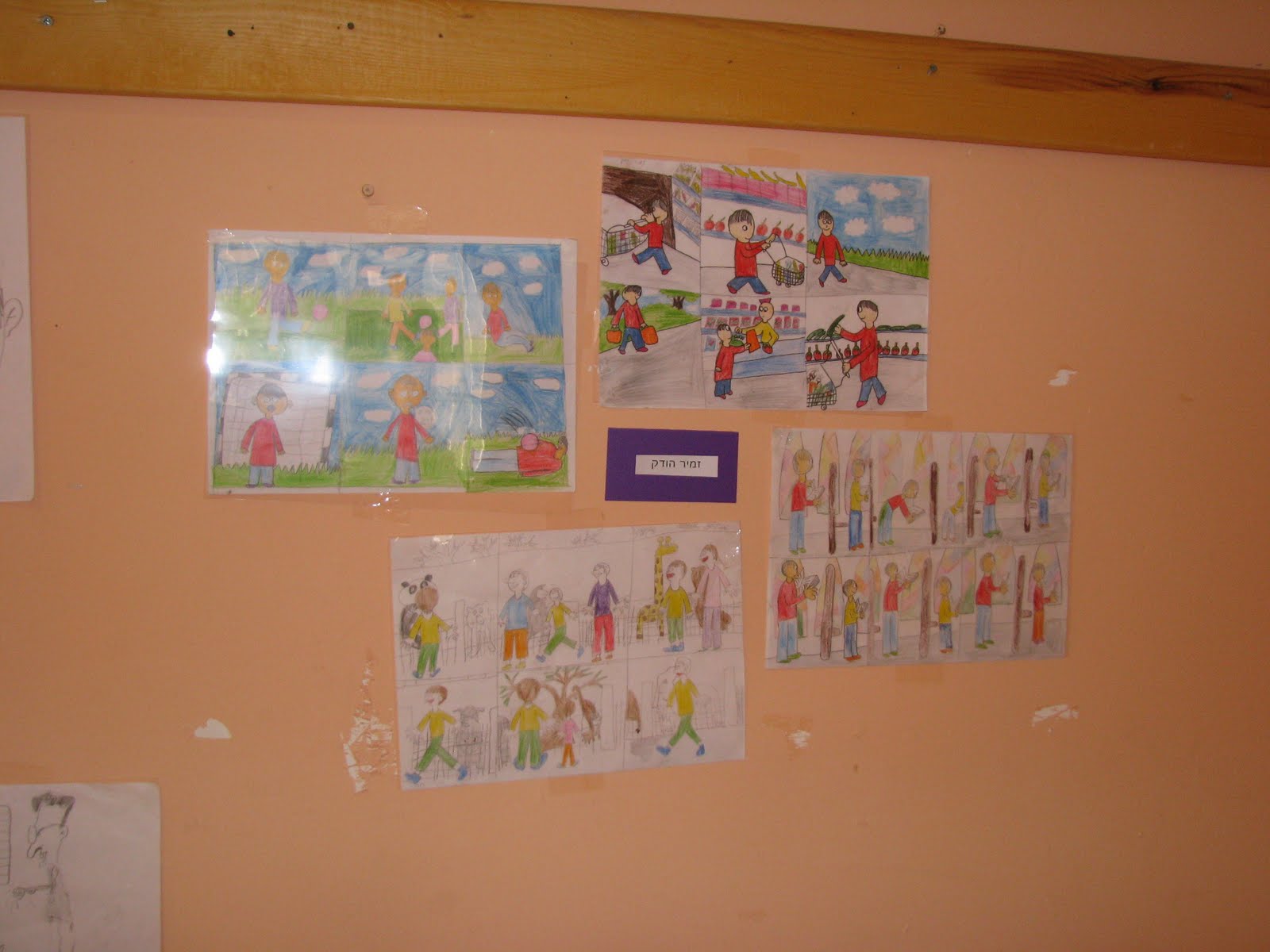
Over the past school year, I had the terrifically fun opportunity to learning to draw comics from the talented comics artist Shlomi Charka. My class included ten 12 year old boys and me. Before the semester ended a teenage girl joined us. We were an interesting mix, but we did very well together. You can read about in here:
http://voices-magazine.blogspot.com/2009/11/intergenerational-gems.html
All year, Shlomi Charka taught us the elements that went into make a great comic - story line, character, perspective, shadows, color, etc. Then it was up to us to draw away.
Often, I found myself laughing at loud in class at the comments of my fellow artists. There was one boy who was constantly drawing political figures - Obama, Bibi, Peres, Lieberman. I said, "You're 12. Why are you drawing Obama. Draw a soccer game." He smiled, "I'm older than my years."
Other boys teamed up with comics on space creatures and shlemazel friends. They laughed and fought and worked and came out with pretty clever comic strips.
Our year of comics has ended. I can't wait to do it again!!!
Meanwhile, our comics have been hung in the exhibit area of the Efrat Library. Almost everyone from our class is represented. I'm sorry not everyone handed in their work. We're proud of each other's comics, and I think we really enjoyed drawing together.
You are invited to the Efrat Library Exhibit Hall to view the COMICS of Shlomi Charka's Comic Club. Bring your kids. You never know, it might awake a budding cartoonist in your child or yourself.

Thursday, July 15, 2010

15th Anniversary of Givat HaDagan

This month, the community of Efrat and supporters worldwide celebrate the 15th anniversary of the struggle for the Dagan Hill, Givat HaDagan. Today, the Dagan is the home to a popular yeshiva, Yeshivat Siach. Back in 1995, it was Efrat's farthest hill, and one of only rocks and distant hopes.
The Dagan overlooks a Jewish National Fund-Keren Kayemet Forest and Solomon's Pools, both of which, unfortunately, have been given over to the authority of the Palestinian Authority. (BTW, Solomon's Pools – which is no longer in Jewish hands - is a vital part of the water system that brought water from the Hebron area to the Temple Mount during the times of the Holy Temple. The aqueduct runs parallel to Efrat, all along its western side. Many families and teens hike in this aqueduct. It is a fabulous tourist attraction that links the present with our Jewish past 2000 years ago.)
BRIEF HISTORY OF OUR STRUGGLE FOR THE DAGAN
The Oslo Agreement had unfortunately been signed. It seemed very clear that any area with Jewish houses would remain in Jewish hands, and any area bereft of Jewish life would be given to the Palestinian Authority.
Efrat's municipal border reached as far north as the Dagan and the Tamar, however it had never been settled fully past its fourth Hill - Dekel. It was beginning to put caravans on its newest hill (at the time) Givat HaZayit.
Unfortunately, the families were not on the hill for more than a few days when Arabs began shooting at the caravans.
Nadia Matar, Eve Harow, Marilyn Adler and I wondered how we could help secure our friends on the Zayit. Our decision was to try to settle the Dagan. If we brought Jewish life there, then the Army would have to secure Efrat's northernmost point, and Arabs would not be able to come close to the Zayit.
We called our friends, told them to gather their sleeping bags, food, flashlights and whatever they'd need for an overnight stay, and come along with us on a Zionist tiyul (trip). We didn't tell them where they were headed, but they all agreed.
We traveled very far - allllllllll the way to Givat HaDagan. Today it is a two minute drive from the Zayit, but at that time, it was a mystery.
We spent the day planting and setting up tables and tents. The Army quickly showed up and asked us what we were doing. We said, "We are holding on to our land." They said, "You're makinga picnic. Make sure you are gone before dark."
But dark quickly came, and we looked at one another. "Oh my gosh, it's getting dark!!" We called our husbands, and they came right away to keep guard. We slept in tents on the earth, and tried not to show our fear to one another.
In the morning, we were still on the Dagan!! A victory!!
We were not determined to stay on the Dagan until we were sure that it was firmly in Efrat's hands.
The entire summer, friends and supporters came from all over Israel and even outside of Israel. We had dozens of tents set up all over the hill, and became a kind of Zionist Hotel for anyone wishing to join us.
We had a synagogue with a Torah (Rabbi Shlomo Riskin - Chief Rabbi of Efrat - came up to be with us, as Efrat's Rav Shimon Golan, Alon Shvut's Rav Meidan and others). We had a kitchen run by Avraham ben Arye. We had a first aid/medical center built by Yehudit Sidikman.
(IF YOU REMEMBER MORE THINGS THAT SHOULD BE MENTIONED, PLEASE SEND THEM IN.)
Land of Israel activists and Knesset Members came to visit us. Every night, we sat around a campfire and tried to plan the next day. They asked us, "What do you want?" You know, what deal do you want to cut? We didn't want to cut any deal, we wanted to keep hold of the hill.
It was the beginning of the cellphone era, and I remember my mother (ad 120) was so worried about me, she bought me my first cell phone.
Hundreds of supporters, especially devoted Efratians, stayed on the hill or visited every day. We had shiurim (Torah lessons) and children's activities. We had deep discussions and quiet moments looking at our beautiful land.
We were filled with dust and dirt. Sleeping in a tent all summer left something to be desired (I guess the kids loved it). We didn't have real bathrooms. (At first we had a moving container, that we cut a hole into. Not your ideal bathrooms.)
But we had such a fervor and a love of the land that it was contagious. Everyone who came up to the Dagan was enthused by it, and infused with it.
We had smachot (happy occasions) there - Bar Mitzvot, parties, excitement.
And we had unhappy times - when the Army tried to dry us out, and evacuated us again and again. But we kept returning. Nothing would deter us.
The radio stations started the day with a dedication, "TO THE WOMEN ON THE DAGAN, this song is for you."
You, reading this blog, may well have been one of the women or one of the folks who came up to the Dagan. You're invited to write your thoughts on the comments of this blog.
We were evacuated. The police and some soldiers were brutal. Some cried. Some refused to evacuate us. We saw them standing on the sidelines. The horses charged the hill. It was like a scene out of a terrible movie. We went to jail for a day. We went back up. We were arrested again. Rabbi Riskin and Nadia Matar were thrown into serious jail. We demonstrated outside the jailhouse.
But look. Today, we have a yeshiva on the Dagan, and soon there will be a beautiful neighborhood there. We cannot wait for the day.
If you were never on the Dagan, or you can't remember it very well, here are some links that you can read.
If you were on the Dagan, and you remember it terrifically, then you're invited to write in what you remember.

The struggle for the Dagan was the beginning of the fight for the hills of Eretz Yisrael. The Dagan will one day be filled with Jewish children, and we pray the other hills of Israel will as well.

The Jerusalem municipality and the IDF's Home Front Command are preparing for a massive Gilo fortification program. Some 1,000 apartments will be fitted with bullet-proof windows, at a cost of some 44 million shekels (almost $11 million). Sharon Katz, editor of Gush Etzion's English-language Voices, protests the very conception: "What about bulletproofing the caravans on the Dagan [in Efrat]? And bulletproofing every home, school and car in N'vei Dekalim? ... and bulletproofing the homes on the perimeter of Pesagot? ... and bulletproofing the homes in Hevron? ... Wouldn't it be smarter instead of bulletproofing the entire country, to stop the Arabs who are shooting into every neighborhood? Don't shoot empty buildings - shoot murderers... Instead of bulletproofing the country and letting them continue shooting at us, stop the shooting!"

Friday, July 9, 2010

Rav Yehuda Amital, of blessed memory


I have just returned from a family trip. You can read about it in the 18 previous blogs. Unfortunately upon returning, I just found out that Rav Amital of Yeshivat Har Etzion has passed away. Baruch dayan ha'emet. My next door neighbor Alan Yaniger was a student of Rav Amital, ztz'l, and so, I asked him to write a few words about his Rosh Yeshiva. May Hashem comfort Rav Amital's family and students among the mourners of Zion and Jerusalem.
Rav Yehuda Amital was the founder and Rosh Yeshiva of Yeshivat Har Etzion in Alon Shevut. He survived the Holocaust, escaped to Israel, and after continuing his yeshiva studies at the Hebron yeshiva, eventually became a Rosh Yeshiva himself. Besides being a talmid chacham, he fought in the War of Independence, and participated in the battle of Latrun. After the Six Say War, he became the first Rosh Yeshiva of Yeshivat Har Etzion, later joined by Rav Aharon Lichtenstein.
I was privileged to study at Har Etzion for four years, and Rav Amital left an indelible imprint on my personality and direction in life. He was a great talmid chacham, but I had met other great talmidei chachimim before. What struck me about Rav Amital was not just his erudition, but his personality.
Rav Amital had a passionate love for every Jew. He would frequently warn his Yeshiva students not to be arrogant, and to appreciate what a treasure we have in “baalei batim,” regular simple Jews. He would give of his time to have private conversations with me, discussing basic issues of faith and my personal goals. I always left those conversations feeling important and wiser . Part of his connection with all of Am Yisrael is reflected in the high rank he achieved in the IDF. He impressed on us the extraordinary sacrifices so many in the IDF were making. Talk about rebuilding the temple with “undeserved love” always irritated him – there are plenty of good reasons that Jews of all stripes deserve love, not just those who look like “anshei shlomenu”. He would never put on airs, and could not tolerate any kind of posturing in what was supposed to be the service of Hashem.
He never ceased to be amazed at the rise of the State of Israel, a massive act of “Kiddush Hashem”, after the Chilul Hashem of the Holocaust. He instilled in us the sense that we were in a pivotal moment in history, and that we have to live up to the challenge and participate in the revival of the Jewish nation. The power of his message would send shivers down my spine, particularly during his talks on Yom Haatzmaut. He himself was a symbol of what that revival could be, having gone through the Nazi camps, and building a life, a family, a yeshiva, and a community of disciples who bring his message of Torah and community action to the Jewish people worldwide.
Until I experienced the Rosh Hashanah and Yom Kippur prayers at Har Etzion, with Rav Amital as the Shaliach Tzibur, I did not know what those holidays could be. The passion that he put in to the prayers, combined with utter honesty and humility before G-d, and presence with the community – this all resurfaces in my mind every year during Yamim Noraim, and provides me with the model of what davening really should be.
He often related a story of the Baal Hatanya, in which the Baal Tanya said, that if someone is so involved in learning that he doesn't hear a baby crying in the next room, his learning is “off” (“pagum” in Hebrew). He told his students that their learning must be of uncompromising quality – yet at the same time, they have to hear the baby crying. They have to relate to the Jewish people, and provide them with what is needed.
Those who knew Rav Amital will never forget his scholarship and action, his passion and his common sense, his love of the whole people and his love of every person. May his memory continue to inspire us.

Wednesday, July 7, 2010

Paris Time (#18)

There's a very strange phenomenon that occurs here in Paris - perhaps other spots as well, but I haven't visited them.
It's call the Paris Time phenomenon. Time has a different meaning in Paris than in other places. In fact, it is set back two hours behind any other place.
It's almost midnight, and yet the streets of Paris are teeming with people. The cafes are spilling out on to the boulevard. Tonight, especially, when Spain has just won the World Cup, hordes of teenagers are roaming through the streets with Yellow and Orange flags on their backs, screaming out in delirious triumph.
Even if there had been no Cup, the streets would have been packed. Nightlife begins in Paris after 8:30 or 9 PM. Dinner reservations are rarely made before 8:30, and couples meet for a stroll well after 9.
The day begins later too. Stores do not open until 10 or 11 AM, and then they close from 2:00-4:00 PM because the French must eat their "pain" (bread) and cheese.
Every night in Paris for us has ended at midnight or 1 AM, but it felt like 11. And it's not because we're tourists.
We just returned from the Arch de Triomphe and walked past Victor Hugo Plaza. Haagen Daaz is packed with ice cream lovers, some of whom I met on my explorations here. So I know they're just regular folks.
It's a Paris phenomenon that might confuse folks when they get here, but perhaps if everyone changes his watch, putting in back two hours in time, they'll feel more comfortable.
Hmm, it's about midnight in Paris. It feels like 10. That's just about right.
Bon soir.

Tuesday, July 6, 2010

Jolie Paris

To get to know Paris, we rode the on-off bus, and sat on top to get the best view. Our first site has become the most famous - the Eiffel Tower. Tourists swarmed the site like colorful ants, and African immigrants hawked mini Eiffel Towers and all kinds of souvenirs. Already I worried about what I could bring home to my kids.
The Tower
The highest building in Paris is the Eiffel Tower. It's almost France's most photographed building. I got it from about eight angles. I'm sure that others may have found more. It was built by Gustave Eiffel (yes, that's his real name) as the star attraction of the 1889 International Exposition, and although it was supposed to be pulled down eventually, it's still there and has become THE symbol of Paris.
The Tower needs 60 tons of paint for every face lift. It required the light of 10,000 gas lights in 1889. Today 20,000 bulbs sparkle every evening on the hour. It was the tallest building in the world until the Chrysler building was erected 40 years later in 1929.
Here's a great story about the Tower. Hitler, yimach shmo, came to the Tower when the Nazis marched into Paris. He wanted to take the lift to the top, but it seemed not to work. So he had to walk the 246 steps. As soon as he left, a mechanic fixed the hydraulic gears with a plain screw driver. Vive la France!
We continued on the bus, and in between stops, the radio played old Maurice Chevalier music and torch songs. Why is it that all Paris chanteuses are broken-hearted? "My man treats me so badly. I can't go on." I have yet to hear a happy life-is-good French song.
Speaking of music, every single building before me with its garretts and its rod iron balconies seemed perfect scenes for Gigi and her Grandmama.
The wind whipped through our hair and the sun beat down on us, as we saw Paris spread out before us - Maxim's, L'Opera (its stage holds 450 people), the place where Joan of Arc was killed in 1429, the Louvre (which began with 12 paintings and now home to one of the finest collections in the world), the Arch de Triumph, the place of the guillotine and museums, museums, museums. (While museums are free in London, they're only free on the first Sunday in the month in Paris.)
Paintings and books lined the bridges of the Seine. And the grandeur of the Loueeees was everywhere. The buildings were ornate and sculpted and accented with gold. Tourists strolled along the Seine, browsing and enjoying the perfect Parisian moment.
We enjoyed the tour bus, but the majority of tourists join Parisians in walking throughout the city. I guess that's why most Parisians are so skinny. They're always walking their boulevards and quaint neighborhoods, soaking up the Parisian atmosphere.